
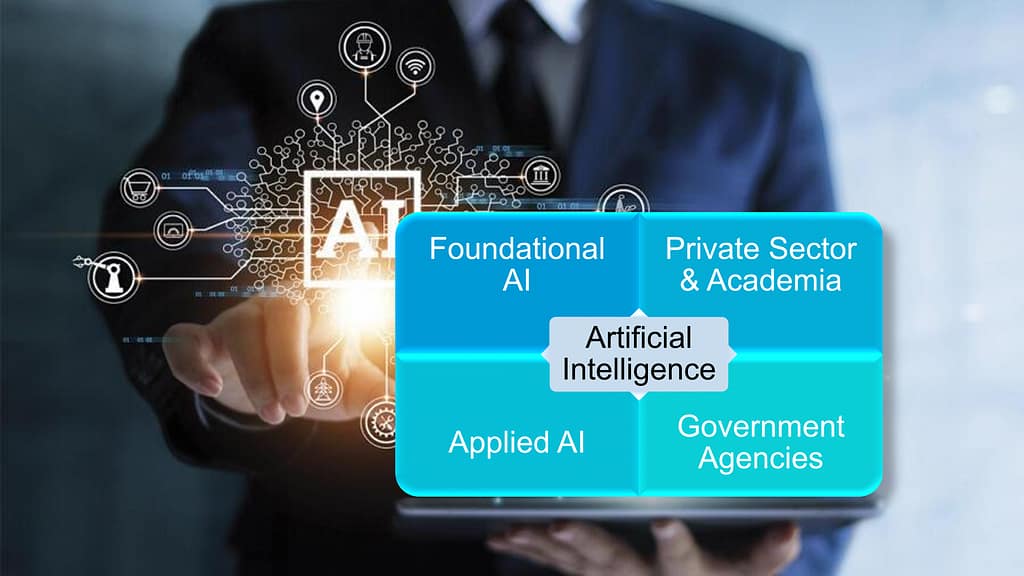
As of 2024, the U.S. federal government’s use of artificial intelligence in contracting remains surprisingly limited. While AI is accelerating across healthcare, marketing, logistics, and mission systems, its application to acquisition and procurement is still in its earliest stages.
Federal agencies have focused primarily on making contracting data available to industry, rather than building government‑owned AI tools that improve acquisition workflows. Industry, in turn, is developing AI‑enabled tools and selling them back to government — a curious inversion that highlights the gap between policy ambition and operational reality.
Three major federal AI hubs illustrate the current landscape:
AI.gov — the government‑wide inventory of AI use cases
AI.mil — DoD’s mission‑focused AI initiatives
AcquisitionGateway.gov — GSA’s acquisition knowledge base
Across these platforms, the numbers tell a clear story. Of the 722 entries in the AI.gov database (2023) only 8 were contracting‑oriented AI efforts and 5 were grant‑oriented AI efforts. This excludes classified work at DARPA, the National Laboratories, and the intelligence community — but even without those, the gap is striking.
Two of the most notable examples come from DoD headquarters:
DORA and DAGIR
These are AI‑enabled business applications designed to support acquisition professionals. DORA, for example, automatically checks SAM.gov, FAPIIS, and tax records to flag vendor exclusions or risk indicators. It doesn’t replace a contracting officer, but it does surface issues that warrant deeper review. These tools are helpful — but they remain exceptions, not the norm.
PIEE: The Platform to Watch
The Procurement Integrated Enterprise Environment (PIEE) should be the natural home for contracting‑oriented AI. Yet as of November 2024, despite the government’s public emphasis on AI, only one PIEE module uses AI and that module is a limited chatbot. This underscores the slow adoption curve in acquisition support systems.
Federal AI adoption splits into two very different worlds:
AI is mature, advanced, and deeply embedded in:
Targeting
Intelligence exploitation
Sensor fusion
Autonomous platforms
AI use is:
Limited
Fragmented
Often experimental
Rarely operationalized
Contracting‑oriented AI tools are especially scarce.
Several factors contribute to the slow adoption:
Rigid hierarchies and risk‑averse cultures slow adoption. AI‑managed processes challenge long‑standing norms.
AI requires:
Large volumes of clean data
Consistent taxonomies
Clear governance
Agencies are wary of giving third‑party AI vendors access to sensitive procurement data.
Potential mission reductions and resource constraints under the Trump 2025 Administration may further limit investment in mission‑support functions, including contracting.
AI systems require:
Continuous tuning
Monitoring
Validation
Governance
This is often underestimated.
Some parts of the acquisition process are well‑suited for AI:
Compliance checks (Sections I & M)
Responsiveness checks
Cost realism and accuracy (with quality data)
Cross‑document consistency
Risk flagging
These tasks are structured, rules‑based, and repeatable. Contracting for healthcare is an area with strong potential because:
The terminology is specialized
The data is structured
The domain is complex but consistent
AI models can be trained effectively
Hand‑crafted narrative sections
Terms and Conditions unique to each solicitation
Tailored Work Statements
Instruction‑driven constraints
Evaluating a vendor’s written technical proposal
These require creativity, nuance, and contextual reasoning — areas where current AI still struggles.
AI in mission systems is widespread and relatively mature.
Policy and guidelines for responsible AI are evolving.
AI for contracting applications remains rare and siloed.
Given political circumstances in 2024–2025, significant advances in acquisition‑oriented AI will likely remain slow.
The acquisition community is trained to be risk‑averse.
Contracting and IT have not historically been closely aligned.
ROI for contracting‑focused AI is difficult to quantify.
We are still in the early evolution of AI tools that do more than act as supercharged research assistants. AI leaders will do well to remember that software engineering fundamentals still apply:
AI is a tool — at its heart, it is software.
AI cannot compensate for poor processes or poor execution.
Dirty data yields biased outputs.
Relevant Match – How it improves your proposals